MGID Ad Library: Browse 54,000+ Live MGID Ads by Advertiser & Geo
No MGID ad library exists — official or otherwise — until now. Inside the 54,585-creative MGID index: the entertainment-arbitrage economy, the direct-response layer, and the most international footprint in native.


MGID has no official ad library. Neither does any third party maintain one — search "MGID ad library" and the results are MGID's own advertiser marketing, generic spy-tool listicles, and nothing that actually lets you look up what is running on the network. For a platform that serves native ads across a claimed 32,000+ publisher sites in dozens of languages, that is a real transparency hole.
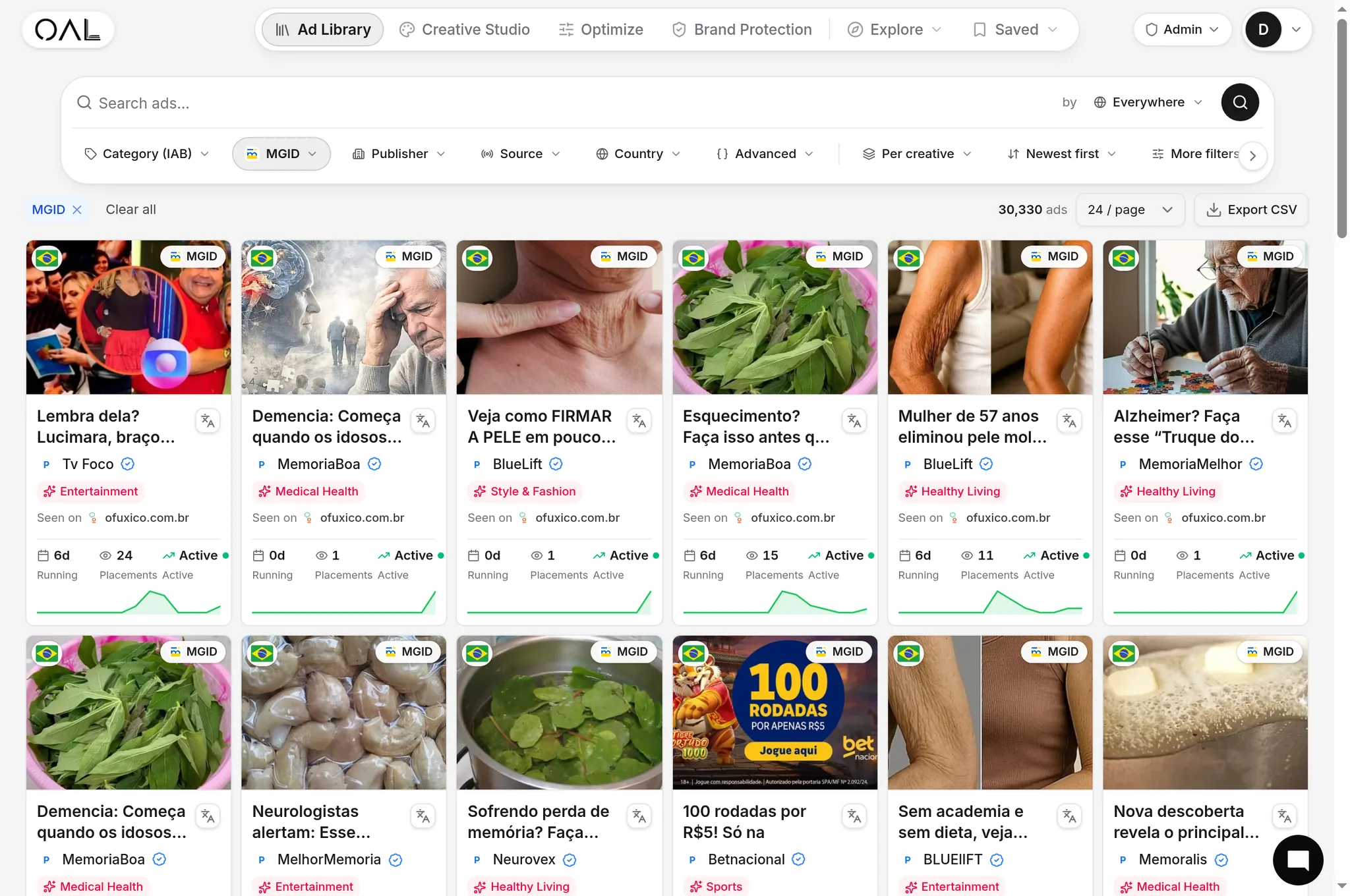
We fill it. As of July 2026, the OpenAdLibrary index holds 54,585 live MGID creatives — 54,391 of them (99.6%) first captured in the last 30 days — each with the advertiser behind it, observed longevity, geo and device data, and a traced landing page. This guide covers why no official MGID library exists, what our index captures, what the data says about the network, and how to use it. The workflow-level companion is our MGID & Revcontent ad spy guide and the /spy/mgid tool page.
Why there is no official MGID library#
The pattern is the same across the native tier — we cover the Taboola and Outbrain versions of this gap in their own guides (Taboola ad library, and the Outbrain equivalent linked below). Public ad libraries exist where regulation forces them: the EU's Digital Services Act obliges very large online platforms to run searchable ad repositories, which is why Meta, Google and TikTok have them. MGID, like every native network, sits below that threshold. Add the commercial reality — MGID's core advertisers are performance and affiliate buyers who would rather their funnels not be one search away — and no official library is coming.
For MGID specifically the gap stings more, because the network's reputation questions make independent data unusually valuable. MGID's own transparency materials describe policy and moderation, not inventory — you can read what the network says it allows, but not what it is actually serving today. Buyers asking "is MGID legit," publishers vetting the demand, and brands checking whether their name is being abused in MGID placements all need to see the actual ads. An outside-in archive is the only way anyone gets that view.
What the MGID index captures#
For each of the 54,585 MGID creatives in the index (July 2026):
- The full-quality creative and headline exactly as served in the widget.
- The advertiser label resolved from the tracking chain — essential on MGID, where bylines like "Health Weekly" or a bare domain name obscure the actual buyer.
- Observed longevity — continuous first-seen/last-seen tracking. Persistence is the public profitability signal; the logic is in our ad longevity guide.
- The traced landing page — followed through the redirect chain without generating billable clicks. MGID funnels are pre-lander-heavy, so this is where the real intelligence lives.
- Geo, device and language — MGID is the most international network we track, and the same offer often runs different creatives per market.
- Vertical classification for filtering.
Here is the network's signature: a StopWatt energy-gadget creative that has been observed running for 30 straight days, which on a network where most ads die in days marks it as a heavily proven angle:

And the other side of MGID's demand — mainstream content-arbitrage buyers like The Penny Hoarder, this creative at 16 days observed:

What the data says about MGID#
MGID's vertical mix looks nothing like Taboola's or Outbrain's. The classified creative counts as of July 2026:
| Vertical | Live MGID creatives (July 2026) |
|---|---|
| Entertainment | 10,225 |
| Health | 696 |
| Insurance | 433 |
| Software | 182 |
| Ecommerce | 159 |
| Real estate | 144 |
Entertainment dominates by an order of magnitude — 10,225 creatives, nearly 15 times the next vertical. That is the content-arbitrage and listicle economy ("celebrity galleries," curiosity slideshows) that MGID monetizes at scale, and it is the honest picture of what most MGID inventory carries. By contrast, on Taboola the top verticals are health (6,857) and finance (5,936). If you are a health or finance buyer evaluating MGID, this table is the context: the direct-response depth is real but thinner, and the network comparison guides — MGID vs Taboola and MGID vs Revcontent — walk through when that trade-off works in your favor.
The advertiser-level data confirms the two-sided character. The largest MGID advertisers in our index are content-arbitrage domains — itsvividleaves.com with 3,088 distinct creatives and factripple.com with 3,071 — followed by direct-response offers like Insulux Diabetic Support (1,807 creatives) and content mills like Brainberries (1,762). And the geography is genuinely global: Betnacional, a Brazilian betting brand, runs 1,287 creatives; Greek (yupiii.gr, 1,149) and Polish (swiatgwiazd.pl, 511) publishers rank among the top buyers. Across our whole index, 61,469 creatives are German, 40,955 Spanish and 20,236 Portuguese — and MGID contributes disproportionately to the non-English share. If your market is outside the US, MGID's library depth in your language is exactly the kind of thing to check before committing budget; our guide to the best affiliate verticals for native ads pairs well with that check.
One more use of the archive that is specific to MGID: brand protection. Mid-tier native networks are where copycat landing pages and brand-impersonation funnels most often surface, and a searchable creative archive is how you catch your brand name or product photos being abused. We wrote up how those schemes work in Copycat Landing Pages: How Scammers Clone Brands in Native Ads.
The two economies of MGID, visible in one archive#
Spend an hour in the MGID index and you stop thinking of it as one network. There are two economies running on the same rails, and the library lets you quantify both.
Economy one: content arbitrage. The itsvividleaves.com and factripple.com tier — thousands of listicle and gallery creatives whose entire business is buying MGID clicks cheaper than the ad revenue those visitors generate on the destination page. This is most of the volume, it explains the entertainment vertical's 10,225-creative dominance, and it sets the tone of the inventory: curiosity headlines, celebrity images, slideshow destinations. If you are buying MGID traffic, these are not your competitors — but they are your auction neighbors, and they define the click quality and price floor you inherit.
Economy two: direct response. Underneath the arbitrage layer sits real performance demand: StopWatt-style gadget offers, nutra brands like Insulux (1,807 creatives) and Vitalis XL, insurance comparison flows, and regional betting brands. These advertisers are conversion-accountable — they only persist if the funnel pays — which makes their longevity data far more meaningful than the arbitrage tier's. When you sort MGID by days observed and filter out the content mills, what remains is a clean list of funnels that survive on unit economics.
The practical read: judge MGID's fit for your offer by economy two, not by the headline creative counts. A health advertiser should look at the 696 health creatives and who is behind them — not be dazzled or deterred by ten thousand celebrity galleries. And when a direct-response angle shows up in both economies (an arbitrage page warming traffic for an offer funnel), you have found the network's favorite trick: the two-step monetization that pre-lander economics are built on.
A worked example: mapping a non-English market#
MGID's international depth is its most under-used research surface, so here is the workflow on a concrete case: suppose you run betting or finance offers and are considering Brazil.
Filter the library to Portuguese-language MGID creatives and the market structure appears immediately. Betnacional alone accounts for 1,287 distinct creatives in the index — hyper-localized down to city-name headlines ("Ei São Domingos do Maranhão!"), which tells you geo-granular creative is table stakes in that market, not a nice-to-have. Sort by longevity and you see which bonus framings and price points ("less than 1 real") persist versus churn. Trace the landing pages and you get the local funnel conventions: registration flows, payment methods referenced, compliance disclaimers used.
That is a market entry brief — competitive set, creative conventions, funnel norms, proven angles — assembled from captured public data in an afternoon, for a market where you may not even speak the language. Repeat it for Greek (yupiii.gr, 1,149 creatives) or Polish (swiatgwiazd.pl, 511) inventory and the pattern generalizes: MGID is often the only native network with meaningful depth in these mid-size markets, which is exactly why an MGID-specific library matters more than the network's mid-tier reputation suggests.
How to use the MGID ad library#
- Search any advertiser or brand. Every MGID creative we have captured from them, with dates, geos, languages and landing pages. This includes searching your own brand to check for impersonation.
- Filter vertical + geo, sort by longevity. The 30-day survivors like the StopWatt creative above are the network's proven angles. Across the full index, only about 2.3% of the 637,514 creatives with longevity data reach the longest-running tiers — the filter does the work of finding them.
- Read the funnels. MGID clicks land on pre-landers and advertorials more often than on offer pages. The traced landing page shows the actual monetization: the offer, the price, the compliance posture.
- Map a market before entering it. Pull your vertical in your target language and you have the competitive set — who is buying, with how many creatives, for how long — before your first test dollar. How MGID Works covers the buying side: formats, targeting and pricing.
- Query it by API. The full MGID corpus is accessible programmatically, same as every network we index.
Freshness, and what this replaces#
Of the 54,585 MGID creatives in the index, 54,391 — 99.6% — were first captured in the last 30 days, the highest freshness rate of the three major native networks we publish libraries for (Taboola runs 98%, Outbrain 99%). That is partly our capture cadence and partly the network itself: MGID's arbitrage-heavy demand churns creative faster than anywhere else, with content mills rotating headline batches daily. The consequence for research is simple — on MGID more than any other network, old data is wrong data. A swipe file from last quarter describes a feed that no longer exists.
Before independent libraries, MGID visibility meant either manual fieldwork — browsing publisher sites across geos and devices, screenshotting widgets that vanish on refresh — or the paid spy-tool tier, where native coverage starts around $79.99/month (Anstrex) and runs to $249/month (AdPlexity Native). Those tools cover MGID among other networks and we rate them fairly in Best Native Ad Spy Tools in 2026, but the price wall kept systematic mid-tier network research out of reach for exactly the solo buyers and small teams most likely to profit from MGID's cheaper traffic. The open-library model — browse free with no card, $29.99/month for full access across all 46 indexed networks — removes that gate.
Honest limitations#
- Deep sample, not a census. 54,585 live creatives is a wide window into MGID, but MGID's long tail of publishers across dozens of markets means no external observer captures everything. Our coverage is deepest in the markets we crawl most heavily.
- Longevity is observed, not lifetime. Our continuous-observation window currently runs to roughly a month; "30 days observed" is a floor on the ad's true age, not its birthday.
- No spend estimates. We publish what we capture — creatives, advertisers, persistence, destinations. We do not model CPCs or budgets, on MGID or anywhere else.
- Classification is automated. Verticals are machine-classified; MGID's entertainment-heavy, clickbait-styled inventory is the hardest to classify cleanly, so treat vertical counts as accurate in aggregate rather than per-creative gospel. A gadget offer wearing a listicle costume will sometimes land in entertainment — which, given how MGID's two economies blur into each other on purpose, is arguably the honest classification.
We publish these edges because a library you cannot calibrate is a library you cannot trust. Every number in this article is a measurement of what we captured, stated with its method — never an extrapolation dressed up as a census.
Library vs. spy tool#
The library is the archive — search it, cite it, browse it. The MGID ad spy tool is the workflow on top: watchlists on competitors, alerts on new creatives, and export into your own creative pipeline. Both read from the same index. The free tier needs no credit card — start free and run your first MGID advertiser search in about a minute.
The bottom line#
No official MGID ad library exists, and none is coming — no regulation requires it and the network's advertisers would not welcome it. The independent alternative holds 54,585 live MGID creatives as of July 2026, 99.6% first seen within 30 days, inside a 635,443-creative index spanning 46 networks and 27,256 advertisers, with 1,081,997 landing pages traced. The data shows MGID plainly: an entertainment-arbitrage giant (10,225 entertainment creatives) with a real but thinner direct-response layer, the most international footprint in the native tier, and — for anyone willing to sort by longevity — a clear list of which angles have already proven they pay.