Outbrain Ad Library: Browse 92,000+ Live Outbrain (Teads) Ads
Outbrain — owned by Teads since 2025 — publishes no ad library. We maintain the independent one: 92,290 live Outbrain creatives with advertisers, longevity and landing pages, and the workflow to use them.

There is no official Outbrain ad library. Search the phrase and you get Outbrain's help-center docs about managing your own campaigns, one competitor blog post, and nothing that lets you actually look up the ads running on the network. Meta, Google and TikTok all publish searchable ad archives; Outbrain — even after becoming part of Teads, a company with a much bigger corporate footprint — publishes none.
We maintain the closest thing that exists. As of July 2026, the OpenAdLibrary index holds 92,290 live Outbrain creatives, and 91,341 of them — 99% — were first captured within the last 30 days. This guide explains why no official library exists, what our Outbrain index contains, how to research advertisers on the network, and the limits of any outside-in archive. For the hands-on competitor workflow, see the Outbrain ad spy guide and the /spy/outbrain tool page.
First, get the corporate picture right#
Most content about Outbrain is working from a pre-2025 map. Outbrain acquired the video and CTV company Teads, closing in February 2025, and the parent company then renamed itself Teads Holding Co. So "Outbrain" in 2026 is a product line — the native recommendation widget you see under articles — owned by a parent called Teads. We covered the merger in detail in Did Outbrain Become Teads? and profiled the combined platform in What Is Teads?.
Why it matters for an ad library: the native demand still lives in the Outbrain widget. In our index, Teads-tagged native creatives number just 86, versus 92,290 for Outbrain. If you want to see what is running on this company's inventory, you look at Outbrain placements, not the Teads brand.
Why Outbrain publishes no ad library#
Same structural reasons as Taboola, which faces the identical gap (we cover it in our Taboola ad library guide). The EU's Digital Services Act forces public ad repositories on very large online platforms — the Metas and TikToks. Native networks distributing ads across thousands of publisher sites sit below that threshold and outside the political-advertising spotlight that created the first libraries. And commercially, an archive of every advertiser's creatives, angles and landing pages is a competitive-intelligence goldmine that the network's own customers would object to.
So the transparency has to come from outside: an independent observer capturing the public placements, archiving the creatives, and resolving who is behind them. That is what we do, across Outbrain and 45 other networks.
What the Outbrain index contains#
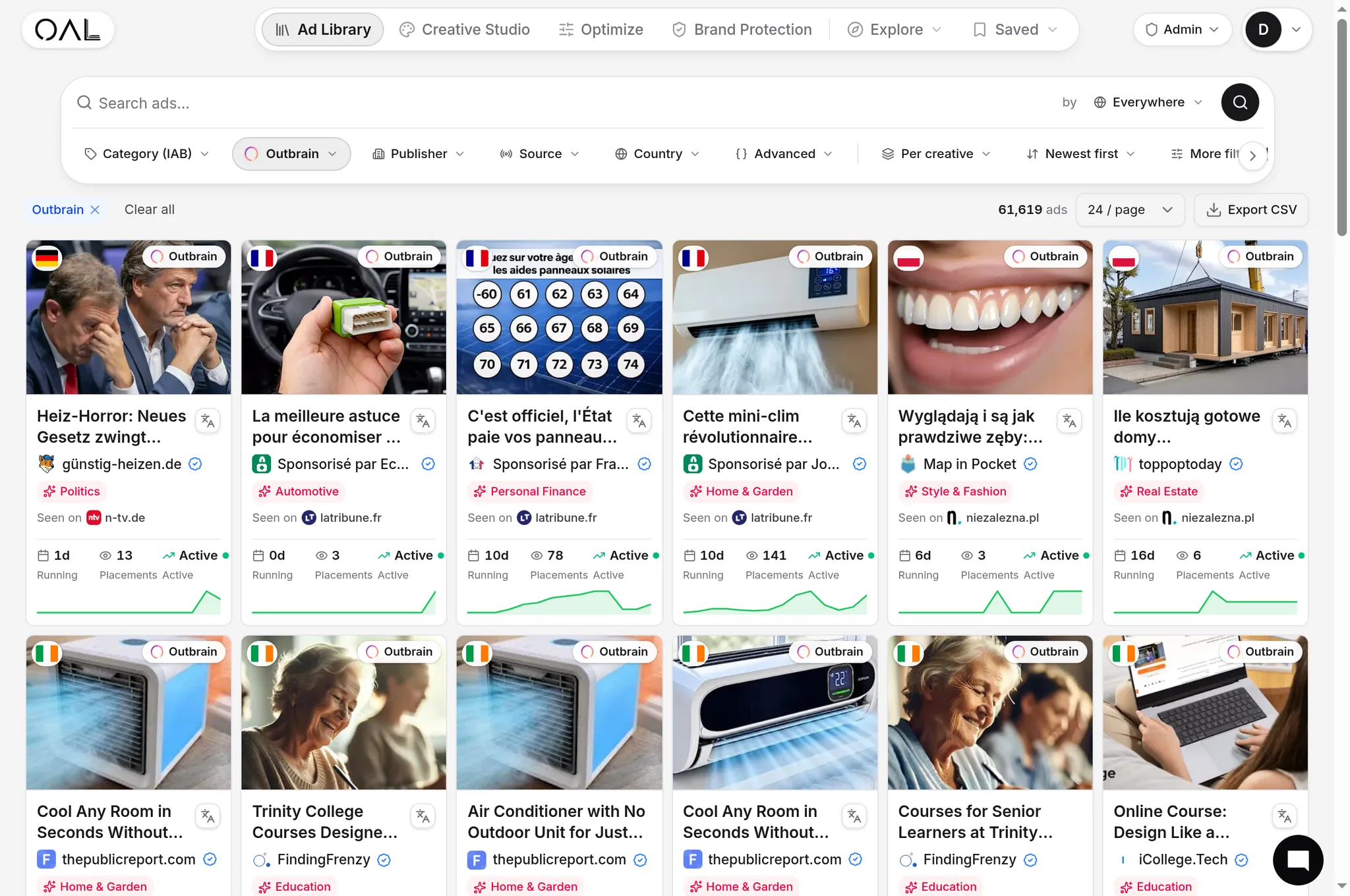
For each of the 92,290 Outbrain creatives in the index (July 2026):
- Full-quality creative and headline as served, not a thumbnail.
- The resolved advertiser behind the placement — critical on Outbrain, where the widget byline is often a vague publisher-style name like "Health Weekly" that tells you nothing about who is paying.
- Observed longevity — first-seen to last-seen from continuous capture. Persistence is the strongest public profitability signal; see why a native ad running 30+ days is probably profitable.
- Traced landing page — we follow the documented redirect chain to the destination without generating a billable click. The full index has 1,081,997 traced landing pages.
- Geo, device and vertical for every creative.
Two real entries. First, the single most persistent finance creative on the network — SmartAsset's IRA angle, observed for 30 straight days:

Second, the classic Outbrain curiosity-gap format — this kitchenware advertorial hook had run 17 days at capture:

The longest-running Outbrain creative in the entire index right now is a home-and-garden advertorial ("Retiree Was Tired of Cyclists Cutting Through His Yard—So He Designed the Perfect Trap") at 31 days of continuous observation — a reminder that on native, the weirdest headlines are often the most tested ones.
What's running on Outbrain: the vertical mix#
Outbrain's demand skews harder toward money verticals than Taboola's. The classified creative counts as of July 2026:
| Vertical | Live Outbrain creatives (July 2026) |
|---|---|
| Insurance | 2,998 |
| Finance | 2,912 |
| Health | 2,224 |
| Ecommerce | 1,629 |
| Software | 1,328 |
| Home & garden | 1,201 |
Insurance and finance sit at the top, effectively tied — on Taboola, health leads. That difference matters if you are picking a network: Outbrain's premium-publisher heritage attracts financial-services demand, and the depth in insurance (2,998 creatives) means an insurance buyer has a full competitive map to study. Put differently: the overall index has Taboola at nearly twice Outbrain's total volume (171,050 vs 92,290 creatives), but in insurance and finance the gap narrows sharply — Outbrain's demand is more concentrated exactly where the highest payouts are. Advertiser-level, the biggest Outbrain advertisers in our index include EpiCooler with 1,203 distinct creatives and Weedmaps with 893 — and the presence of a German "Anzeige" label cluster (441 creatives) and a Hebrew-labeled cluster (1,139) shows how international the widget's demand is. For the cross-network advertiser view, see Top Native Advertisers on Taboola, Outbrain & MGID.
How to research advertisers on Outbrain#
- Look up any advertiser. Search a brand and get every Outbrain creative we have captured from them, with dates, geos and landing pages. This is the query an official library would answer, and the one Outbrain's help docs cannot.
- Sort a vertical by longevity. Filter to your category and geo, sort by days observed. The creatives at the top — like SmartAsset's 30-day IRA ad — are the proven angles. On a network where most creatives die within days, persistence is the signal.
- Follow the click. Outbrain funnels lean heavily on advertorials and pre-landers. The captured landing page shows the offer, price and compliance posture. Our funnel reverse-engineering guide covers reading these end to end.
- Compare against Taboola. The same advertiser often runs both networks with different creative sets. Checking both sides of our index shows where their budget conviction actually sits — the method is laid out in Taboola vs Outbrain.
- Automate it. Everything is accessible via API and MCP, so your scripts or AI agents can query the Outbrain index directly.
If you first need grounding in how the network works — the DSP side, publisher placements, bidding — start with How Outbrain Works in 2026.
A worked example: reading an Outbrain advertorial funnel#
Here is what one library lookup produces in practice. Start from the SmartAsset creative above — the "Ask a Pro" IRA-tax angle observed for 30 straight days.
First, the advertiser view: searching SmartAsset returns their full captured Outbrain creative set, and the pattern across headlines is textbook financial-services native — question-format hooks ("How Can I Avoid..."), age- and asset-bracket qualifiers, and an authority frame ("Ask a Pro") that pre-sells the advisory service before the click. The 30-day persistence of this specific variant against the shorter lifespans of its siblings tells you exactly which formulation of the angle won.
Second, the funnel trace: the captured landing path shows whether the click lands on a direct offer page or — far more common on Outbrain — an advertorial pre-lander that warms the reader before the conversion form. Reading three or four competitors' funnels side by side in the library shows you the structural consensus of the vertical: how long the pre-landers run, where the form sits, what compliance language appears, which trust signals they lead with. That structure is the expensive knowledge; each of those advertisers paid real traffic to converge on it, and the library hands it to you read-only.
Third, the cross-network check: the same search on the Taboola side of the index shows whether the advertiser runs the identical angle there, a different one, or nothing. An angle running unchanged on both networks is portable and probably robust. An angle exclusive to Outbrain suggests the advertiser learned it performs differently across networks — which is itself a finding worth having before you allocate a test budget.
Freshness: why 99% of the corpus is under 30 days old#
Of the 92,290 Outbrain creatives in the index, 91,341 — 99% — were first captured within the last 30 days. That figure is worth dwelling on, because it defines what kind of tool this is.
Native creative rotates fast: losing variants die within days, and even winners get refreshed weekly with new images and headline tweaks. An Outbrain archive dominated by last year's creatives would describe a network that no longer exists — post-merger, post-rotation, post-everything. A corpus where effectively the whole thing entered within the past month is a live mirror of the network as it currently runs, which is the only version you can compete against. The trade-off is stated plainly in the limitations above: we optimize for the live picture and recent history, not multi-year archaeology.
The freshness rate also quietly measures the network itself. Outbrain's 99% 30-day intake (versus 98% on Taboola) reflects similar churn dynamics on both — advertisers on each network are shipping and killing creatives at nearly the same tempo, which means on either one, last quarter's swipe file is already stale.
What this replaces (and what it costs)#
Before independent libraries, seeing Outbrain at this resolution meant one of two things. Either manual fieldwork — browsing publisher sites in different geos on different devices behind VPNs, screenshotting widgets, and losing every ad the moment the page refreshed — or an enterprise spy-tool subscription, with the established native tools listing between roughly $79.99/month (Anstrex) and $249/month (AdPlexity Native). Those tools are capable, and we compare them honestly in Best Native Ad Spy Tools in 2026, but the price wall meant most solo buyers and small teams simply never got systematic Outbrain visibility.
The open-library model changes the entry point: browse free with no card, and full access at $29.99/month — including the other 45 networks in the index, so the Outbrain view comes bundled with Taboola, MGID and the mid-tier rather than sold as a separate product.
The brand-side use case#
Media buyers are the obvious audience for an Outbrain library, but the fastest-growing set of lookups we see is defensive. Outbrain's heritage is premium publishers — its widgets sit on brand-name news sites — which makes it exactly where a brand's reputation problems become visible. Three searches worth running if you manage a brand:
- Your brand name. Surfaces affiliates running unauthorized angles on your product, review-style advertorials trading on your name, and outright impersonation. Because the library archives creatives with dates and landing traces, what you find is evidence, not just a sighting.
- Your product category plus your claims. Competitors' advertorials frequently benchmark against the category leader by name. If that is you, you want to know the framing before your customers quote it back to you.
- Your executives or spokespeople. Celebrity-endorsement fabrication is a recurring native-ads scam pattern, and it favors exactly the premium-adjacent inventory Outbrain carries. Finding it early — with the landing page captured — is the difference between a takedown request and a viral mess.
None of these searches is possible against the network itself, because there is nothing official to search. That asymmetry, more than any media-buying edge, is the public-interest case for independent ad libraries.
Honest limitations#
- A deep window, not omniscience. We observe public placements continuously across publishers, geos and devices. 92,290 live creatives is a serious sample of the network, but no outside observer sees every Outbrain impression everywhere. Thin geos and niche publishers mean occasional blind spots.
- Longevity is a floor. "Observed 30 days" means our continuous-observation window — currently around a month — has seen it that long. The ad may predate our first capture.
- No spend, no performance metrics. We do not display CTRs, conversions or budget estimates, because we do not have them and will not fabricate them. What we show is captured, not modeled.
- English-heavy, not English-only. The index spans 15+ languages (61,469 German and 38,325 French creatives among them), but coverage depth varies by market.
Library vs. spy tool#
The library answers "what exists on Outbrain": browse, search, cite. The Outbrain ad spy tool layered on top answers "how do I act on it": competitor watchlists, alerts when a tracked advertiser ships new creatives, and one-click paths from a captured ad into your own creative workflow. Both read from the same 92,290-creative index, and the free tier requires no card — start free and search any Outbrain advertiser now.
The bottom line#
Outbrain — now a Teads company — offers no official ad library, and the market has quietly accepted that the transparency will come from independent observation instead. As of July 2026 our index holds 92,290 live Outbrain creatives, 99% of them first seen in the past 30 days, each with the resolved advertiser, observed longevity, geo and device facets, and a traced landing page. That is a complete research surface for the network: enough to map any advertiser's playbook, rank a vertical's proven angles by persistence, and read the funnel behind every headline before you spend a dollar of your own.