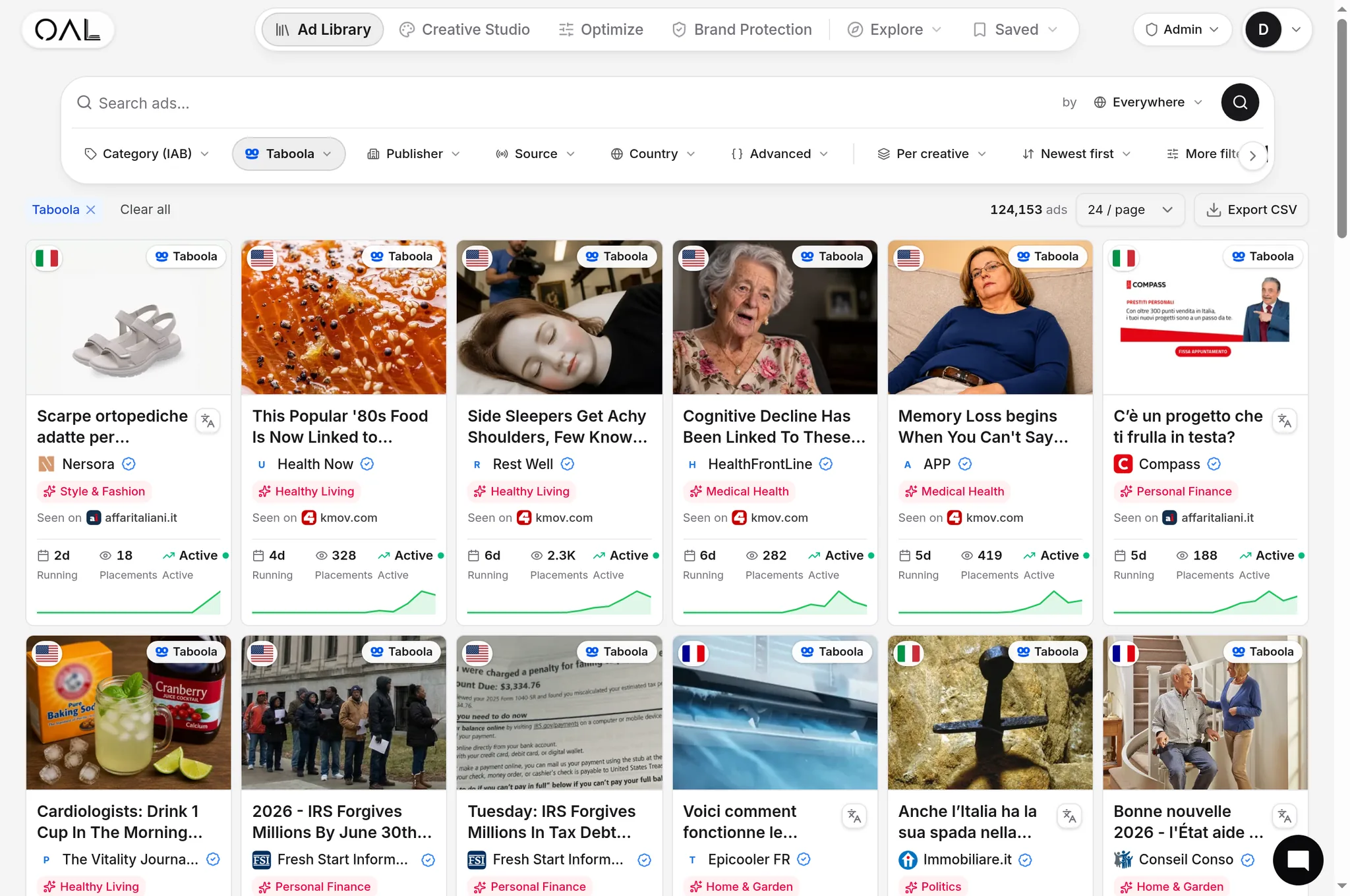
10 Taboola Ad Examples Captured Live (And Why Each One Works) — 2026
Ten real Taboola creatives pulled live from a 171,050-ad index — with the advertiser behind each, how long it's been running, and the headline mechanism doing the work: eligibility hooks, casting-call angles, editorial blends, geo-personalization and offer-led cards.


Most "Taboola ad examples" round-ups are screenshots of five-year-old creatives someone found on a blog, with no evidence they ever spent a dollar. This gallery is different: every example below is a real Taboola creative captured live by OpenAdLibrary in the last 30 days (as of July 2026), with the actual image, the actual headline, the advertiser we resolved behind it, and — the metric that matters most — how many days it has been running. Taboola is the second-largest source in our index at 171,050 captured creatives, so these aren't cherry-picked unicorns; they're representative of what's actually filling the feed right now.
We've organized the examples by the mechanism that makes each one work, because that's the transferable part. Copy a headline and you get one ad; understand the mechanism and you can write fifty. If you want the theory first, read hook vs. angle vs. claim — this page is the applied version.
A note on selection: we didn't pick these for shock value. The set deliberately spans the feed's real composition — lead-gen specialists (hearing aids, senior rebates), a healthcare brand doing compliant content marketing, a global airline, a bank, an investment firm and a publisher buying audience — because the most useful thing an example gallery can show you is that different advertiser types win with different mechanisms in the same feed. Days-running figures are as observed at capture in July 2026; each creative's clock keeps ticking (or stops) after that.
1. The eligibility hook: "Government Rebates for Over 60s [Check Eligibility]"#

Advertiser: Senior Savings · Running: 13 days
The single most durable formula in native advertising: a benefit the reader might already be entitled to, gated by a qualification step. Three mechanisms stack here. The demographic callout ("Over 60s") makes the reader feel personally addressed. "Government" borrows institutional authority. And the bracketed "[Check Eligibility]" turns the click into a self-interested verification task rather than an ad response. Thirteen days of continuous delivery says the economics work — in a feed where, per our index-wide data, roughly nine in ten creatives die within ten days, surviving to day 13 is a real signal.
2. The casting-call angle: "Wanted: Australians who want to try High-Tech Hearing Aids"#

Advertiser: auditorey.com · Vertical: Health · Running: 4 days
"Wanted:" reframes a product pitch as a recruitment notice — the reader isn't being sold to, they're being selected. Add the geo callout ("Australians") and a novelty qualifier ("High-Tech") and you get an ad that reads like an opportunity with limited seats. This is a classic hearing-aid lead-gen play, and it's a fresh creative (4 days), which usually means the advertiser is rotating variants to fight fatigue.
3. The benefit-shift variant: "Gov't Now Pays For Your Hearing Aids (See If You Qualify)"#

Advertiser: auditorey.com · Vertical: Health · Running: 19 days
Same advertiser as #2, different mechanism — and that's the real lesson. The casting-call variant is 4 days old; this eligibility variant has run 19 days. When one advertiser runs two angles and one outlives the other nearly five-to-one, you're watching a live A/B test with the budget as the vote. "Now" implies a recent policy change (urgency without a fake countdown), and the parenthetical qualifier does the same job as example #1's brackets. Watching competitor angle tests like this is exactly the workflow in how to analyze winning native ad creatives.
4. The editorial blend: "Lung Cancer Screening: What Australians Ask Most"#

Advertiser: I-MED Radiology Network · Vertical: Health · Running: 19 days
This is native-blend done by a legitimate healthcare brand: a headline structured like a health-desk FAQ article, indistinguishable in tone from the editorial cards around it. No claim, no urgency — just a question the target demo is already quietly asking. Nineteen days of delivery for a brand campaign is notable, and it shows the same feed that carries aggressive lead-gen also works for compliant brand content when the headline respects how Taboola's feed actually works.
5. The explainer variant: "Australia's Lung Cancer Screening Program Explained"#

Advertiser: I-MED Radiology Network · Running: 11 days
I-MED again, testing "Explained" against "What Australians Ask Most." Both variants survive (11 and 19 days), which suggests the topic is doing the work and the brand is scaling reach with parallel creatives rather than hunting a single winner — a pattern we see constantly among sophisticated advertisers when we map a competitor's full creative set.
6. The seasonal-local hook: "Escape to cooler New South Wales"#

Advertiser: Singapore Airlines · Running: 10 days
Five words. The mechanism is context: served to Singapore-region readers in the equatorial heat, "cooler" is the entire pitch and "Escape" is the verb that sells it. Big brands often fail on native by porting display taglines; this works because it's written like a feed headline — a promise, a place, no logo-speak.
7. The sensory listicle: "Snow, sea and springtime blooms in Sydney and New South Wales"#

Advertiser: Singapore Airlines · Running: 15 days
The sibling creative to #6, and the longer-lived one (15 vs. 10 days). Instead of one benefit it stacks three concrete images — snow, sea, blooms — a rhythm that reads like a travel feature, not an ad. Two live variants from one brand, again: the airlines run their native programs the way affiliates do, they just do it with better photography.
8. The offer-led card: "Up to S$22 off with minimum spend every weekend"#

Advertiser: HSBC Credit Cards · Vertical: Ecommerce · Running: 21 days
The longest runner in this gallery at 21 days, and the least "native" headline of the ten — it's a straight promo. Why does it survive? Specificity and recurrence: an exact amount (S$22), a clear condition (minimum spend), and a repeating window ("every weekend") that keeps the offer perpetually current. When a bank keeps a Taboola creative alive for three weeks, the funnel behind it is converting; that's the longevity-as-signal logic in action.
9. The geo-personalized finance angle: "Retirement Income: Exclusive Tips for Singaporeans"#

Advertiser: Fisher Investments Singapore · Vertical: Finance · Running: 2 days
Fisher Investments runs some of the most disciplined native funnels we track (its US arm has a 31-day creative on the Microsoft feed — see our finance native ads breakdown). The formula: category keyword ("Retirement Income"), exclusivity cue ("Exclusive Tips"), nationality personalization ("for Singaporeans"). Finance is Taboola's #2 vertical in our index at 5,936 classified creatives, and this template — topic + exclusivity + demonym — is a huge share of it.
10. The content-arbitrage card: "All the biggest trends in luxury hospitality in Asia this 2026"#

Advertiser: Prestigeonline.com · Running: 3 days
A publisher buying feed traffic to its own editorial — the audience-development / arbitrage pattern that quietly fills a large share of every native feed. The headline is pure editorial packaging ("All the biggest trends… this 2026"): superlative + niche + recency. If you're wondering who's really behind the cards in your feed, this category is a bigger slice than most advertisers expect — we break the advertiser mix down in who advertises on Taboola.
The headline formulas behind these ten ads#
Strip the ten real headlines above and you get five reusable templates:
| Formula | Real captured example | Mechanism |
|---|---|---|
| Benefit + audience + [qualifier] | "Government Rebates for Over 60s [Check Eligibility]" | Eligibility self-check beats sales pitch |
| "Wanted:" / recruitment framing | "Wanted: Australians who want to try High-Tech Hearing Aids" | Reader is selected, not sold to |
| Authority + "Now" + parenthetical | "Gov't Now Pays For Your Hearing Aids (See If You Qualify)" | Implied policy change = urgency without a countdown |
| Question/FAQ editorial structure | "Lung Cancer Screening: What Australians Ask Most" | Blends into the news feed it runs in |
| Specific offer + recurring window | "Up to S$22 off with minimum spend every weekend" | Concrete number + perpetual freshness |
Two cross-cutting observations from the gallery. First, demonyms and geo-callouts appear in half the examples ("Australians," "Singaporeans," "New South Wales") — feed audiences respond to being located. Second, the survivors are qualified, not loud: the 19-21 day creatives all gate the click ("See If You Qualify," "minimum spend") while the flashiest headlines churn fastest. We tracked this pattern at index scale in native ad headlines: what 600K+ creatives teach.
The images earn a paragraph of their own, because they follow patterns just as tight as the headlines. Across these ten: real-looking people mid-action beat studio shots (the hearing-aid and screening creatives), product-in-context beats product-on-white (HSBC's card, the airline's destination photography), and the image's job is to stop the scroll while the headline does the persuading. Nothing in the set uses text-overlay-heavy display styling — creatives that look like ads die fastest in a feed whose whole premise is looking like content.
A note on geography: these ten were captured across our Australia and Singapore feed monitoring; the mechanisms are universal, but always validate angles in your target geo since Taboola's mix shifts sharply by country.
What these ten say about the Taboola feed as a whole#
Zoom out from the gallery and the index-level numbers explain why these particular mechanisms keep appearing. Taboola's classified vertical mix in our capture (July 2026) leads with health (6,857 creatives), finance (5,936), insurance (4,961) and ecommerce (3,688), with home & garden (2,961) and software (2,395) behind — which is why hearing aids, retirement tips and bank offers dominate any honest sample. Taboola runs on premium news publishers, and regulated, senior-skewing categories are what that context monetizes.
The advertiser mix is stranger than most gallery posts admit. The single most prolific Taboola advertiser in our 30-day window is Yahoo Search, with 4,184 creatives — search-arbitrage demand, not a consumer brand — followed by portfolio players like WonderMapped (2,543) and OTTO Insurance (2,337 creatives, longest running 30 days). In other words, the feed is a three-way ecosystem: brands (Singapore Airlines, HSBC, I-MED), lead-gen specialists (auditorey, Senior Savings), and a traffic-trading economy buying clicks to resell. Each writes headlines differently, and once you can tell them apart you read the feed completely differently — the full breakdown is in who advertises on Taboola and our top advertisers by network ranking.
Turnover is the other constant. Taboola generated 167,524 fresh creatives in the last 30 days — nearly its entire 171,050-creative library — which means the median ad you see today didn't exist a month ago. That churn is precisely why days-running is such a powerful filter: in a feed that replaces itself monthly, anything that persists three weeks has been re-bought daily by an advertiser watching the numbers.
How to build your own Taboola example library#
Static galleries — including this one — age. The creatives above were live in July 2026; some will be dead by the time you read this, and their replacements will tell you what's working then. To run this analysis yourself:
- Open the Taboola ad library view and filter by your vertical and geo.
- Sort by days running — longevity separates funded winners from launch-week noise.
- Open each advertiser to see their full variant set (like auditorey's two angles above) and follow the traced landing page to the funnel.
- Save the patterns, not the pixels — remix the mechanism, never copy the creative.
- Re-run the pull monthly. Given the feed's 98% monthly turnover, the gallery you build in July is a historical document by September; the durable asset is your formula list, refreshed against whatever is surviving now.
Browse live Taboola ads free — the free tier requires no card — or start a full account to unlock longevity sorting, advertiser drill-downs and landing-page traces across all 171,050 Taboola creatives (and 635,443 total) in the index as of July 2026.